When developing smart packaging, promotional products, functional labels, or color-changing consumer goods, selecting the correct thermochromic pigment activation temperature is a key product design decision.
Thermochromic pigments do not behave like a digital switch that changes color at exactly one temperature. Microencapsulated leuco-dye pigments typically transition through a temperature range. The selected activation point must therefore match the product’s operating environment, substrate, and intended user interaction.
Choosing the wrong temperature can cause premature color changes during storage or prevent the pigment from responding effectively during normal use.
1. Understanding Thermochromic Pigment Activation Temperatures
Thermochromic pigments generally respond reversibly to temperature changes. As temperature rises, the pigment may become lighter, transparent, or change to another color. When the temperature decreases, the original color can return.
For product development, activation temperatures can generally be divided into three application ranges:
| Temperature Series | Typical Range | Main Trigger | Common Applications |
|---|---|---|---|
| Low Temperature | 8°C–25°C | Refrigeration, ice, chilled environments | Beverage labels, ice cream packaging, cold-chain indicators |
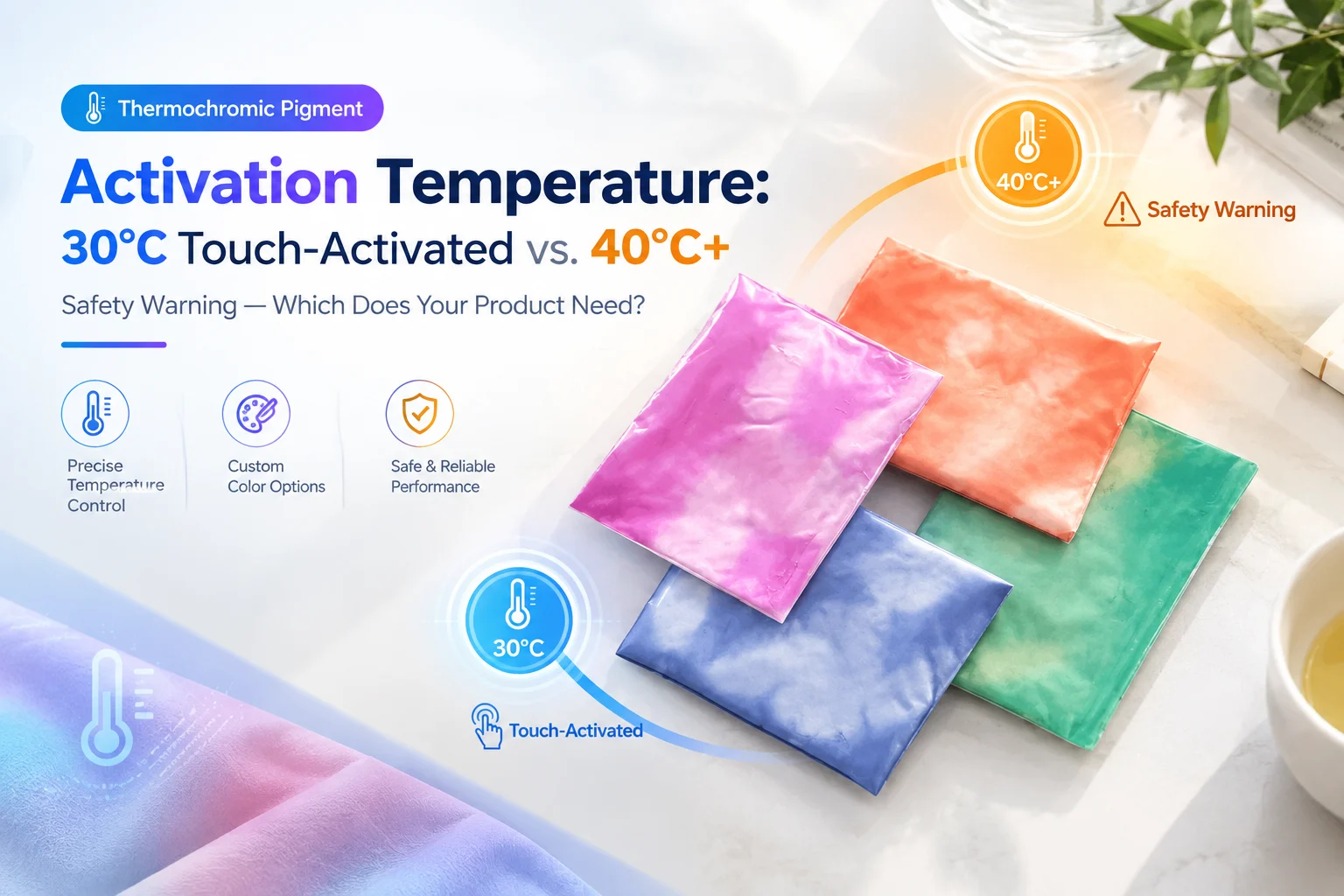
| Touch Activated | 30°C–38°C | Human skin or hand contact | Interactive packaging, toys, apparel, promotional products, security labels |
| High Temperature | 40°C–70°C | Hot liquids, steam, friction, equipment heat | Hot beverage warnings, baby safety products, industrial labels |
The correct thermochromic pigment temperature depends on how and where the end product will be used.
2. Low-Temperature Thermochromic Pigments: 8°C–25°C
Low-temperature grades are designed for applications triggered by cooling.
Typical applications include:
- Cold beverage and beer labels
- Ice cream packaging
- Refrigerated products
- Ice bucket indicators
- Cold-chain temperature indicators
For example, a pigment designed around 10°C–15°C can remain relatively stable at normal room temperature while producing a visible color response when the package is sufficiently chilled.
This temperature range is particularly useful when the color change needs to communicate that a product has reached a preferred serving or storage condition.
3. Touch-Activated Thermochromic Pigments: 30°C–38°C
Touch-sensitive thermochromic pigments respond to heat transferred from the human hand or skin.
The commonly specified activation points include 31°C and 33°C. Human skin surface temperature typically falls around 32°C–34°C, allowing these grades to respond effectively to direct contact.
Common applications include:
- Interactive product packaging
- Promotional products
- Color-changing toys
- Thermochromic apparel
- Security seals
- Consumer electronics accessories
For general touch applications, a 31°C thermochromic pigment provides a commonly used starting point.
For products sold in warmer environments, developers may consider 33°C–35°C to reduce the possibility of unwanted activation caused by ambient temperatures.
4. High-Temperature Thermochromic Pigments: 40°C–70°C
High-temperature thermochromic pigments are designed for applications where the color response needs to occur above normal ambient and body temperatures.
Typical activation points include 43°C, 45°C, and 60°C.
Applications include:
- Hot beverage warning labels
- Coffee cup sleeves
- Baby bottle safety indicators
- Industrial heat warning labels
- Machinery temperature indicators
- Heat-sensitive promotional products
For hot beverage applications, a 43°C–45°C activation temperature can provide a visible warning before the surface reaches more hazardous temperatures.
5. Why Thermochromic Pigments Do Not Change Color at One Exact Temperature
One of the most important considerations when selecting a thermochromic pigment activation temperature is the transition window.
A pigment rated at 31°C, for example, does not necessarily remain unchanged until exactly 31°C and then immediately become transparent.
Typical 3°C–5°C Transition Window
Thermochromic pigments can gradually change color across a temperature range.
A pigment specified around 31°C may begin losing color intensity around 29°C and approach full transparency around 33°C.
Therefore, product developers should evaluate the complete transition curve rather than treating the nominal temperature as a precise on/off point.
Thermal Hysteresis
Thermochromic pigments can also show different behavior during heating and cooling.
For example, a pigment may reach its transparent state around 33°C during heating but require cooling to approximately 27°C–28°C before fully returning to its original color.
This temperature difference is known as thermal hysteresis.
The substrate can also influence response speed. Thick plastic components retain heat longer than thin paper coatings, which can affect both color-change speed and recovery time.
6. How to Choose the Correct Activation Temperature
Product developers should evaluate three main factors before selecting a thermochromic grade.
Identify the Trigger Temperature
Determine what will activate the pigment:
- Ice or refrigeration
- Human touch
- Warm water
- Hot beverages
- Mechanical friction
- Industrial equipment heat
The activation point should sit within the actual temperature range generated by the trigger.
Consider the Ambient Environment
The pigment must remain stable during transportation, storage, and retail display.
For example, selecting a 25°C pigment for a touch-sensitive product could result in unwanted activation in a warm warehouse or summer retail environment.
Conversely, a 38°C pigment may respond too slowly to normal hand contact.
Evaluate the Substrate and Processing Method
The same pigment may behave differently depending on the application format.
Common forms include:
- Thermochromic powder
- Water-based slurry
- Printing ink
- Screen-printing coating
- Plastic masterbatch
Developers should also verify processing temperatures, especially for plastic applications. For injection molding, the pigment’s thermal stability must be compatible with the selected polymer and processing conditions.
7. Thermochromic Pigment Selection Matrix
| Target Application | Trigger | Recommended Activation Temperature | Suitable Form | Key Consideration |
|---|---|---|---|---|
| Cold Beverage / Beer Can | Ice or refrigeration | 10°C–15°C | Water-based slurry / flexographic ink | Maintain strong visual contrast |
| Touch-Activated Packaging | Finger or palm contact | 31°C | Powder / thermochromic ink | Use thin layers for efficient heat transfer |
| Hot Beverage Warning | Hot liquid | 43°C–45°C | Screen-printing ink/coating | Trigger before surface temperature becomes hazardous |
| Color-Changing Toys & Mugs | Warm water/hand grip | 33°C–38°C | Powder/plastic masterbatch | Verify thermal stability during molding |
8. Can Thermochromic Pigments Be Customized?
Standard thermochromic grades are commonly available at temperatures such as 15°C, 22°C, 31°C, 45°C, and 65°C.
For specialized applications, custom formulations can be developed across approximately -10°C to 70°C, according to the specifications provided in the source material.
Customization can be considered for different manufacturing formats, including:
- PP, PE, and ABS plastic masterbatch
- Water-based flexographic inks
- Textile screen-printing coatings
- Specialty packaging coatings
The formulation should be selected according to the required transition temperature, substrate, processing conditions, and final application.
9. Key Considerations When Selecting Thermochromic Pigments
The correct thermochromic pigment activation temperature depends on more than the nominal temperature printed on a product specification sheet.
Before bulk production, buyers and product developers should confirm:
- Target activation temperature
- Full transition range
- Heating and cooling behavior
- Thermal hysteresis
- Substrate thermal conductivity
- Pigment form and application method
- Processing temperature
- Storage and operating environment
- Required color-change contrast
- Compatibility with the final product
A 31°C thermochromic pigment is commonly suitable for human-touch applications, while 10°C–15°C grades suit chilled products and 43°C–45°C grades are appropriate for many heat-warning applications.
The final selection should always be validated through application-specific testing before mass production.
Conclusion
Selecting the right thermochromic pigment activation temperature requires matching the pigment’s thermal response with the product’s actual environment and user interaction.
Low-temperature pigments support chilled-product indicators, 30°C–38°C grades enable touch-activated effects, and 40°C–70°C grades support heat-warning applications.
Because thermochromic pigments transition across a range rather than at a single exact temperature, developers should also account for the 3°C–5°C transition window, thermal hysteresis, substrate properties, and processing conditions.
For B2B product development, testing the selected pigment on the final substrate before production is essential for achieving predictable and repeatable color-change performance.