
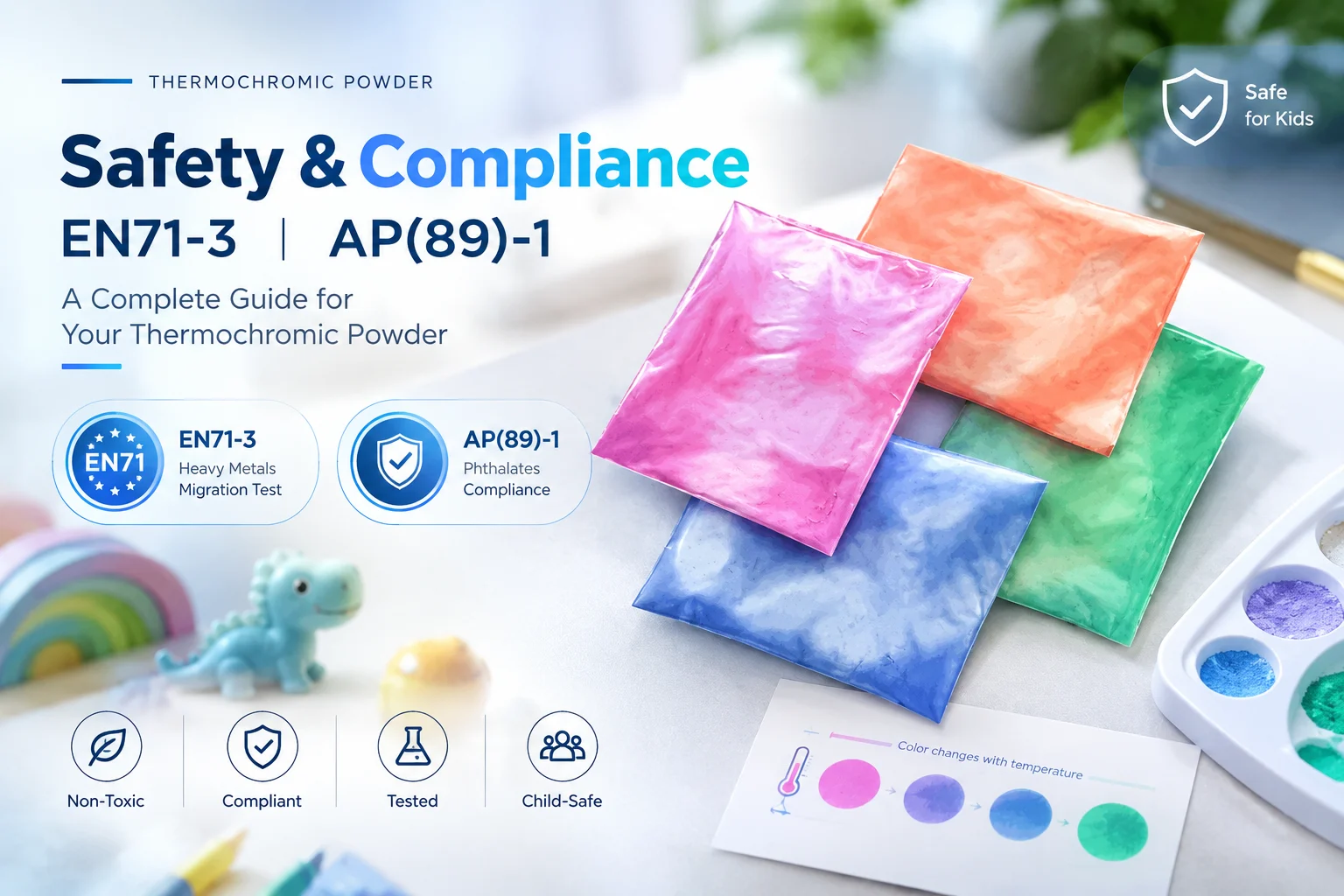
Thermochromic pigment powder is widely used in temperature-sensitive toys, creative products, promotional items, and nail art applications. However, for B2B buyers, product safety involves more than a supplier’s claim that a pigment is non-toxic, odorless, or eco-friendly.
Thermochromic pigment powder safety depends on application-specific regulatory compliance, chemical composition, and microcapsule integrity. Buyers must verify the relevant test reports, confirm that the documentation covers the intended end product, and establish practical incoming inspection procedures.
For manufacturers, importers, and private-label brands, these checks help reduce product recalls, production defects, and compliance risks. This guide explains which documents to request, how to evaluate microcapsule quality, and what to check before approving a thermochromic pigment supplier.
1. What Safety Documents Should You Request for Thermochromic Pigment Powder?
The required documentation depends on the destination market, product category, and how the thermochromic pigment will be used.
A pigment intended for children’s toys may require different evidence from one used in nail products, food-contact materials, or general decorative applications. A single declaration cannot automatically establish compliance across all these scenarios.
Key Compliance Documents for Thermochromic Pigment
| Document or Standard | What It Helps Verify | Important Consideration |
|---|---|---|
| EN 71-3 test report | Migration of specified elements from toy materials | Covers the applicable migration requirements, not every aspect of toy safety |
| REACH-related documentation | Compliance with applicable EU chemical restrictions and obligations | Confirm the relevant substances, restrictions, and reporting requirements |
| RoHS declaration or test report | Restrictions on specified hazardous substances in applicable electrical and electronic equipment | Not a universal certification for all consumer products |
| Safety Data Sheet (SDS) | Chemical hazard information, handling, storage, and emergency measures | Does not independently prove that a finished product is safe or compliant |
| Food-contact compliance documentation | Suitability against applicable food-contact requirements | Must match the material, intended use, temperature, contact duration, and target market |
| Cosmetic compliance documentation | Suitability for the intended cosmetic application | Verify applicable colorant restrictions and cosmetic product requirements in the destination market |
1.1 EN 71-3: Heavy Metal Migration for Toy Applications
EN 71-3 addresses the migration of specified elements from toy materials under defined test conditions. It is an important consideration when thermochromic pigment is incorporated into toys or other materials covered by the applicable toy safety framework.
However, an EN 71-3 test report alone does not establish complete toy safety compliance. Other requirements may apply depending on the product, including mechanical and physical safety, flammability, chemical restrictions, and labeling.
Before purchasing toy-grade thermochromic pigment powder, buyers should request the actual test report and confirm:
- The tested material and pigment formulation.
- The applicable standard edition and test method.
- The specified elements and corresponding results.
- Whether the tested sample represents the supplied product.
- Whether additional testing is required for the finished toy or composite material.
For children’s products, the relevant requirements depend on the intended age group, product classification, and destination market.
1.2 REACH and RoHS: Check the Scope Before Approval
REACH and RoHS serve different regulatory purposes.
REACH concerns the registration, evaluation, authorization, and restriction of chemicals within its scope. RoHS restricts specified hazardous substances in applicable electrical and electronic equipment.
A supplier’s REACH or RoHS declaration should identify the relevant requirements and provide supporting evidence where necessary. Neither should be treated as a universal safety certificate for every thermochromic pigment application.
For electronic promotional products or temperature-sensitive consumer devices, buyers should determine whether the pigment, finished component, or final product falls within the applicable requirements.
1.3 Food-Contact Applications: Do Not Assume Pigment Is Food-Grade
Thermochromic pigment used in drinkware, food packaging, or food-contact plastics requires a separate suitability assessment.
AP(89)-1 is a Council of Europe resolution concerning the use of colorants in plastics intended to come into contact with food. Its relevance depends on the jurisdiction and the applicable regulatory framework. It should not be treated as a universal approval for every food-contact application.
Buyers should confirm:
- Whether the colorant is permitted for the intended food-contact use.
- Which migration or purity requirements apply.
- Whether the pigment is incorporated into a suitable, compliant polymer system.
- Whether the final article requires additional migration testing.
- Whether the proposed application complies with the target market’s current regulations.
A pigment described as food-grade is not automatically suitable for direct contact with food or beverages. The complete formulation and intended conditions of use must be assessed.
1.4 Nail Art Applications: Verify Cosmetic Suitability
Thermochromic pigment used in nail polish, gel polish, or other cosmetic products requires a different compliance review from toy or food-contact applications.
Depending on the destination market and intended use, buyers may need to assess permitted colorants, ingredient restrictions, product safety documentation, and finished cosmetic requirements.
For example, cosmetic products placed on the EU market are subject to the applicable requirements of Regulation (EC) No 1223/2009. Colorant suitability must be checked against the relevant provisions and intended use.
Before selecting a thermochromic pigment for nail art, request ingredient information and application-specific safety documentation. Do not assume that food-contact documentation or a generic non-toxic statement establishes cosmetic suitability.
2. Why Microcapsule Wall Integrity Matters
Thermochromic pigment powder commonly uses microcapsules containing a temperature-sensitive color-changing system. Depending on the formulation, the encapsulated components may include a leuco dye, a developer, and a solvent or phase-change medium.
The microcapsule wall helps protect the internal system and supports reversible color change. If the capsules are damaged during manufacturing, transportation, storage, or processing, the pigment may lose performance or become less stable.
Potential warning signs include:
- Unexpected changes in color response.
- Reduced color-changing contrast or reversibility.
- Poor dispersion, visible streaks, or abnormal agglomeration.
- Increased fine particles or other deviations from the approved particle-size profile.
- Unusual surface residue or leakage-like marks that require further investigation.
These signs do not independently prove capsule failure. They indicate that the batch should be investigated using appropriate testing.
2.1 Particle Size Distribution and Fine Particle Content
Particle size affects dispersion, coating uniformity, processing behavior, and final appearance. For microencapsulated thermochromic pigments, particle-size data can also help identify deviations from the supplier’s established production profile.
Ask the supplier for a particle-size distribution report using an appropriate method, such as laser diffraction or sieve analysis where suitable.
During incoming inspection, compare the results with the approved specification and historical batch data.
Pay attention to:
- D10, D50, and D90 values where reported.
- Unexpected increases in fine particles.
- Unusual agglomeration or a broader distribution.
- Differences between the incoming batch and the approved reference sample.
A higher fine-particle fraction may indicate a process or handling issue, but it does not prove that microcapsule walls have fractured. Particle-size measurements should be interpreted alongside microscopy, dispersion, and functional performance tests when necessary.
2.2 Dispersion Uniformity in the Actual Binder or Carrier
Thermochromic pigment must perform consistently in the intended formulation. A powder that disperses well in one carrier may behave differently in another because of differences in viscosity, polarity, additives, and processing conditions.
Before mass production, conduct a dispersion trial using the actual binder, coating, ink, polymer, or other intended carrier.
Check for:
- Visible agglomerates.
- Uneven color distribution.
- Streaks or speckling in the finished layer.
- Changes in viscosity or processing behavior.
- Unusual residue or other deviations from the approved sample.
Use the supplier’s recommended mixing procedure and processing limits. Excessive shear, incompatible solvents, or unsuitable temperatures may affect microcapsule performance.
A successful dispersion test supports process compatibility, but it does not replace chemical safety testing or regulatory verification.
2.3 Color-Change Temperature and Reversibility
Thermochromic pigment is selected partly for its transition temperature and color-changing behavior. Processing conditions that exceed the recommended limits may affect the encapsulated system or reduce product performance.
To verify batch consistency, compare the incoming pigment with an approved reference sample under controlled conditions.
Record:
- The color-change onset or transition range.
- The heating and cooling conditions.
- The initial and changed colors.
- Reversibility after repeated temperature cycles.
- Any visible degradation after the intended processing trial.
The acceptance range should be based on the product specification rather than an assumed universal temperature tolerance.
For B2B buyers, the objective is to verify repeatable color performance under actual application conditions, not simply to confirm that the powder changes color once.
3. A Practical Incoming Inspection Checklist for Thermochromic Pigment
A standardized incoming inspection process helps purchasing and quality teams compare suppliers objectively and detect batch deviations before production.
| Inspection Stage | What to Verify | Acceptance Basis |
|---|---|---|
| Documentation review | SDS, applicable test reports, declarations, batch identification | Documents match the product, formulation, and intended use |
| Visual inspection | Packaging condition, visible contamination, caking, unusual residue | Consistent with the approved sample and specification |
| Particle-size review | D10/D50/D90 or other agreed particle-size metrics | Within agreed limits |
| Dispersion trial | Agglomeration, streaking, and distribution uniformity | Meets the approved formulation and appearance requirements |
| Color-response test | Transition behavior, color contrast, and reversibility | Meets the product’s agreed performance specification |
| Processing trial | Stability under specified mixing and application conditions | No unacceptable deviations under the defined process |
| Batch traceability | Lot number, production records, and relevant test documentation | Complete and consistent with purchasing requirements |
Recommended Supplier Approval Process
Step 1: Define the end use. Identify whether the pigment will be used in toys, decorative crafts, nail products, electronics, coatings, or food-contact materials.
Step 2: Establish applicable requirements. Determine the regulations, restricted substances, testing standards, and documentation required for the destination market.
Step 3: Review supplier documentation. Check product identity, formulation, report scope, test method, and sample traceability.
Step 4: Approve a reference sample. Record the agreed color response, particle-size profile, dispersion behavior, and relevant physical properties.
Step 5: Validate processing compatibility. Test the pigment in the intended carrier and under the planned manufacturing conditions.
Step 6: Apply batch-level acceptance criteria. Compare incoming shipments against the approved specification and investigate deviations before release.
This process helps reduce the risk of accepting a pigment that appears satisfactory but fails during production or subsequent compliance assessment.
4. Frequently Asked Questions About Thermochromic Pigment Powder Safety
Q1. Can thermochromic pigment powder be used in children’s toys?
Potentially, provided the pigment and finished toy meet the applicable requirements for the intended product and destination market. EN 71-3 may be relevant for migration of specified elements, but additional toy safety requirements may apply. Request the actual test report and confirm that its scope matches the intended use.
Q2. Is a non-toxic declaration enough to approve thermochromic pigment?
No. A generic non-toxic statement does not establish compliance with a specific regulation or prove suitability for every application. Buyers should request applicable test reports, ingredient or material information, an SDS, and evidence relevant to the finished product.
Q3. Does thermochromic pigment for nail art need food-contact certification?
Not simply because it is used in nail art. Cosmetic applications require an assessment against the applicable cosmetic rules in the destination market. Food-contact requirements address a different use case and do not automatically establish cosmetic suitability.
Q4. How can buyers identify damaged thermochromic microcapsules?
Start by checking for unusual fine particles, agglomeration, surface residue, and changes in color response. Compare particle-size data and dispersion behavior with an approved reference sample. Where the cause remains uncertain, use suitable microscopy or additional technical testing rather than relying on visual inspection alone.
Q5. Does a particle-size report prove that microcapsule walls are intact?
No. Particle-size distribution is useful for monitoring consistency, but it cannot independently confirm capsule integrity. Combine particle-size data with dispersion tests, controlled color-response trials, and additional analysis when warranted.
Q6. What documents should buyers request from a thermochromic pigment supplier?
The document package should match the application. It may include an SDS, applicable heavy-element migration reports, relevant chemical compliance declarations, food-contact or cosmetic suitability documentation where required, particle-size data, and batch traceability records.
Q7. Can one thermochromic pigment formulation serve toys, nail art, and food-contact products?
Not automatically. Different applications may have different chemical, migration, ingredient, and finished-product requirements. Buyers should confirm the suitability of the specific formulation for each intended use before production approval.
5. Source Thermochromic Pigment Powder with Application-Specific Documentation
For B2B buyers, selecting thermochromic pigment powder involves more than choosing a color or transition temperature. Regulatory suitability, microcapsule stability, dispersion performance, and batch consistency all influence the reliability of the finished product.
At Baolai, buyers can discuss thermochromic pigment specifications, intended applications, sample evaluation, and available compliance documentation with the technical team.
Before ordering, confirm which reports are available for the exact formulation and whether they cover your intended market and application.