
In the world of traditional art, a color is usually a fixed entity—a static choice made at the moment of creation. However, the emergence of “intelligent” colorants has transformed the canvas from a passive surface into a living, breathing participant in the environment. By utilizing luminous pigments, photochromic powders, and thermochromic dyes, crafters can now create pieces that respond to the hidden rhythms of the world.
Imagine a handmade pendant that remains crystal clear indoors but suddenly “blooms” into a vibrant violet the moment you step into the sun. Or a piece of custom jewelry that changes from charcoal to emerald the second it touches your skin. These are not just visual tricks; they are “interactive narratives.” This article provides a comprehensive guide to the science and creative application of dynamic pigments, showing how you can use them to design hidden stories within your handmade soaps, resin crafts, and accessories.
1. The Science of the “Shift”: Decoding Light and Heat Interaction
To master the art of color-changing crafts, one must first understand the molecular magic happening beneath the surface. Dynamic pigments act as sensors, reacting to specific energy triggers.
Photochromic Pigments: The Pulse of the Sun
Photochromic pigments are essentially light-sensitive molecules. When these molecules encounter ultraviolet (UV) radiation—specifically the “invisible light” from the sun—their molecular structure undergoes a reversible transformation.
-
The Reaction: Indoors, where UV light is filtered by glass or absent, the molecules are in a “closed” state, often appearing colorless or white.
-
The Bloom: Once exposed to sunlight, the molecules “open” like a flower, absorbing specific wavelengths of light and manifesting as vibrant reds, blues, or yellows.
Thermochromic Pigments: The Language of the Body
Thermochromic pigments operate on the principle of temperature-induced change. These are often micro-encapsulated liquid crystals or leuco dyes.
-
The Threshold: Each pigment has a “critical temperature” (such as , or ).
-
The Dialogue: When the environment or the wearer’s body heat crosses this threshold, the pigment changes from its “colored” state to its “clear” state (or shifts between two colors). This allows the artwork to react to a human touch, a warm breeze, or a hot beverage.
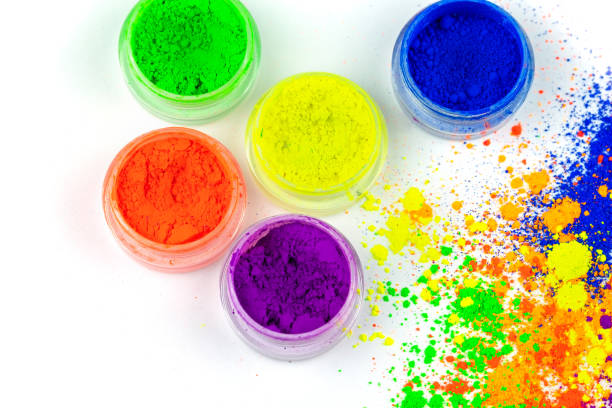
2. Beyond Static Glow: The Role of Luminous Pigments
While light and heat pigments handle daytime interaction, luminous pigments (phosphorescent powders) manage the transition into the night.
The Energy Battery
Luminous pigments act like a natural “energy battery.” They absorb ambient light—whether from the sun or a lamp—and store it in their crystal lattice. Once the external light source is removed, they release that energy as a soft, ethereal glow.
-
Synergy in Design: By combining photochromic powders with luminous pigments, you create a “triple-story” piece: one color indoors, a second color in the sun, and a glowing silhouette in the dark. This ensures that the art never “sleeps,” constantly evolving as the day progresses.
3. Creative Guide: Designing Hidden Narratives
The true magic of these materials lies in the concept of “The Reveal.” Here is how to apply these properties to common handmade projects.
Handmade Soaps: The Vanishing Secret
By incorporating thermochromic pigments into a clear glycerin soap base, you can design “interactive cleanliness.”
-
Design Idea: Embed a small toy or a waterproof message inside the soap, obscured by a thermochromic “fog.” As the user washes their hands with warm water, the “fog” clears, revealing the hidden treasure or message within. This turns a daily chore into a moment of discovery.
Resin Jewelry: The Environmental Companion
Resin is the perfect medium for luminous pigments and UV-sensitive powders because its transparency allows light to reach every particle.
-
Design Idea: Create a “Solar Garden” earring set. Use photochromic pigments to paint white flower petals on a clear resin base. When the wearer steps outside, the flowers “grow” into a vivid bouquet. This interactive element makes the jewelry a conversation starter, as it literally reacts to the wearer’s surroundings.
Phone Cases and Stationery: The Personal Touch
Because phone cases are in constant contact with our hands, they are the ideal canvas for thermochromic art.
-
Design Idea: Use a heat-sensitive pigment that activates at (just below human body temperature). Paint a dark, mysterious forest on the case. When the user holds the phone, their palm print creates a “clearing” in the forest, revealing a bright, neon-colored world underneath.
4. Technical Tips for Pigment Success
Working with “smart” pigments requires a bit more finesse than standard glitter. Follow these technical guidelines to ensure your colors remain vivid and responsive.
-
Avoid Overheating: While thermochromic pigments respond to heat, excessive heat (such as a torch used to pop resin bubbles) can permanently damage the micro-capsules. Always add pigments when the medium has cooled slightly.
-
UV Protection vs. UV Activation: If you use a UV-resistant topcoat on a photochromic project, you might accidentally block the very light needed to trigger the color change. Use clear, high-quality finishes that allow UV penetration.
-
Mixing Ratios: Dynamic pigments are highly concentrated. Typically, a to ratio by weight is sufficient. Over-saturating the medium can make the “clear” state look muddy.
-
Base Color Choice: Always remember that most photochromic and thermochromic pigments transition to “clear.” Therefore, the background color of your project will be what shows through during the transition. A white or light-colored base usually provides the best contrast.

5. The Emotional Impact: Why Interactive Art Matters
In an era of mass-produced goods, “interactivity” is the ultimate luxury. When a piece of art reacts to its owner, it ceases to be a product and becomes a companion.
-
Surprise and Delight: The sudden change of a color triggers a dopamine response in the brain. It reminds us of the wonder we felt as children.
-
Customization: No two interactions are identical. The way a thermochromic ring changes color on your finger is different from how it looks on mine, creating a unique “biological signature” for the artwork.
-
Narrative Depth: These pigments allow artists to hide “Easter eggs” in their work. A message of “Stay Bright” that only appears in the sun carries more weight than a message that is always visible.
6. Conclusion: Mastering the Alchemy of Color
The integration of luminous pigments, photochromic powders, and thermochromic dyes represents a new frontier in the handmade movement. We are no longer limited to the “Visible Light” spectrum; we are now painting with temperature, ultraviolet energy, and stored phosphorescence.
By mastering the “Chemistry of Change,” you can transform simple materials into sophisticated storytelling tools. Your works will no longer just sit on a shelf; they will bloom in the morning sun, react to the warmth of a hand, and glow with a secret light in the shadows of the night. In the world of Bangsai-level creativity, art is not something you just see—it is something you experience.