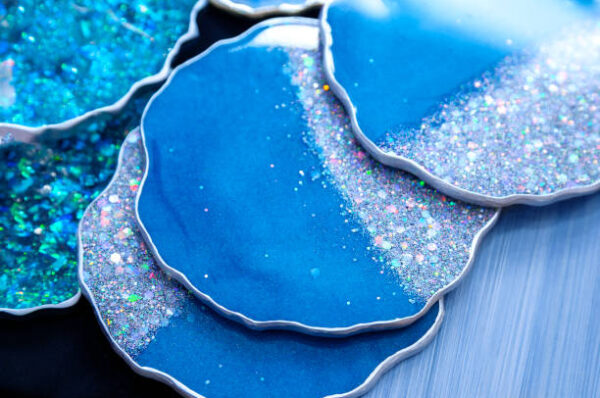
 In the realm of high-end aesthetics—be it in automotive coatings, cosmetic formulations, or bespoke resin art—color is no longer a static observation. We have entered an era where color is dynamic, multidimensional, and structurally engineered. At the heart of this visual revolution lies mica powder, a material often misunderstood as mere “glitter.”
In reality, modern pearlescent pigments are masterpieces of nano-engineering. By utilizing light interference coating technology, we can now design a spectrum that spans from the soft, moonlit glow of natural pearls to the avant-garde “color-shifting” effects of a distant galaxy. This article deconstructs the materials science behind these pigments, revealing how we manipulate light at the nanometer scale to create “Structural Color”—a form of beauty that is purer, more durable, and more multidimensional than any traditional pigment.
1. Beyond the “Glitter” Myth: The Physics of Structural Color
To appreciate the “Galactic” effects of premium mica, one must distinguish between pigment color and structural color. Traditional pigments (like those in a box of crayons) work through absorption; they soak up certain wavelengths of light and reflect the rest.
The Mirror of Physics: Thin-Film Interference
Mica powder operates on the principle of thin-film interference—the same phenomenon that creates the rainbow swirl on a soap bubble or an oil slick.
-
The Substrate: We start with a microscopic flake of mica (either natural or synthetic). This flake acts as a transparent “window.”
-
The Coating: Through a process called chemical vapor deposition, we coat this flake with a nanometer-thin layer of metal oxides, most commonly Titanium Dioxide () or Iron Oxide ().
-
The Magic: When light hits the pigment, some reflects off the top of the coating, and some travels through the coating and reflects off the mica surface. These two light waves then “interfere” with each other. If they are in sync, the color is amplified; if they are out of sync, the color is canceled.
2. The Nanometer Palette: Designing the Spectrum
In the laboratory, the “palette” isn’t a brush—it’s a timer and a pressure gauge. The thickness of the metal oxide coating determines exactly which color the human eye perceives. By controlling this thickness at a nanometer (nm) level, we can design the entire spectrum.
The Coating Thickness Roadmap:
| Resulting Color Effect | Visual Characteristic | |
| Silver White | Classic pearlescent glow; high brightness and purity. | |
| Interference Gold | Warm, regal luster; shifts between yellow and transparency. | |
| Interference Red/Pink | Romantic, soft hues; highly popular in cosmetics. | |
| Interference Blue/Violet | Cool, ethereal tones; used for “high-tech” aesthetics. | |
| Interference Green | Lush, organic shifts; reminiscent of beetle wings or emeralds. |
By layering different oxides (e.g., placing a layer of iron oxide over titanium dioxide), we can create metallic lusters like deep bronze, copper, and “Galactic” shifting effects where the color changes depending on the angle of the viewer.
3. High-Purity Substrates: Natural vs. Synthetic Mica
The “purity” of the fantastical color depends heavily on the “window” (the mica substrate).
-
Natural Mica: Harvested from the earth, it contains trace minerals that give it a slightly warm, “champagne” undertone. It is prized for its organic, soft luster.
-
Synthetic Mica (Fluorphlogopite): Created in a high-temperature furnace, this substrate is ultra-transparent and free of impurities. Because it is clear, the interference colors appear more saturated and vivid. For “Galactic” or “Holographic” effects, synthetic mica is the gold standard because it allows the interference colors to “pop” without any yellowing interference.
4. The Advantages of Structural Color in Design
Why choose interference mica over traditional chemical dyes? The benefits extend far beyond mere “shimmer.”
A. Superior Lightfastness and Stability
Traditional dyes often fade under UV exposure (sunlight) because their chemical bonds break down. Structural color is physically permanent. As long as the physical coating remains on the mica flake, the color will never fade. This makes it ideal for exterior automotive paints and architectural coatings.
B. “Three-Dimensional” Depth
Traditional flat paint absorbs light, making the surface look “heavy.” Interference mica allows light to penetrate multiple layers of the coating. This creates a “depth” where the color seems to float beneath the surface, giving the object a 3D, sculptural quality.
C. Safety and Non-Toxicity
Because the color is created through light physics rather than harsh chemical reactions, mica pigments are generally non-toxic and skin-safe. They are the preferred choice for eco-friendly “clean beauty” brands and high-end artisanal soaps.
5. Application Guide: Bringing the “Galaxy” to Life
To achieve the “Fantastical” effects described, the application method is as important as the pigment itself.
-
Resin Art: For “Galactic” effects, use a black base layer. Interference colors (like Blue or Violet) are most visible against dark backgrounds because the black absorbs the transmitted light, leaving only the brilliant interference reflection for the eye to see.
-
Cosmetics: In eyeshadows or highlighters, varying the particle size is key. Small particles ($<15\mu\text{m}$) create a “satin” or “silk” finish. Large particles ($>100\mu\text{m}$) create a “star-diamond” sparkle where the interference colors twinkle like distant stars.
-
Automotive Coatings: By mixing multiple interference micas (e.g., a Blue-shift mica with a Green-shift mica), designers create “Chameleon” paints that shift through three or four colors as a car drives past, mimicking the fluid motion of a living creature.
6. Conclusion: Architecting the Future of Color
The transition from “seeing color” to “designing light” is the ultimate frontier of material aesthetics. Mica powder is no longer just a decorative additive; it is a tool of optical architecture. By mastering the nanometer-scale thickness of interference coatings, we are able to move beyond the limitations of nature’s palette.
We are no longer restricted by what colors “exist.” Instead, we can engineer colors that “perform”—colors that shift with the sun, glow with a soft pearlescence, or pulse with a galactic intensity. For the creator, the designer, and the engineer, mica powder is the “Silent Commander” of the visual world, turning every surface into a canvas of light.